
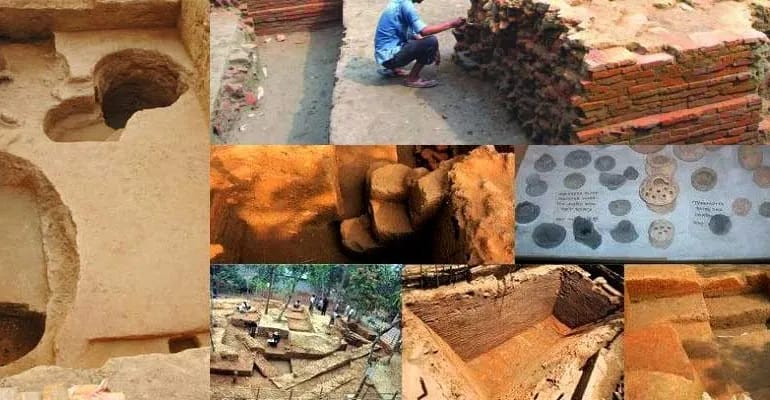
Those who are interested in seeing archeological artifacts can visit the two village-wide archeological sites named Uari and Bateshwar located in Belabo Upazila of Narsingdi in Bangladesh. It is believed to bear the mark of a huge underground fort. Of these two patterns, Uari is larger in size. Wari Bateshwar, a village located in the old Brahmaputra river basin, was known as a river port and international trade center in those days.
First, in 1933, laborers found an urn while digging the soil and it contained the oldest silver coin of Bengal. In 1955, local laborers found two heavy iron ingots, triangular in shape and faceted. After that various archeological artifacts such as Vishnupot, stone beads, iron axe, ballam, bronze vessels etc. were discovered from Uari Bateshwar. Some of these signs have been lost forever due to human ignorance and greed for money. Some of the surviving artefacts are preserved in the private collection of Narsingdi archaeologist Mr. Habibullah and the Bangladesh National Museum.
Many artifacts including forts, cities, roads and coin hoards built around 2500 years ago have been discovered from Uari Bateshwar. A 4000 km silk route connected the rich and prosperous ancient cities of Uari and Bateshwar, mentioned in the book 'Sonagra' by the famous Greek geographer Ptolemy in his book 'Geography'. Hence Uari and Bateswar are considered as the oldest Mahajanapadas of Bangladesh.
 ColoZai