
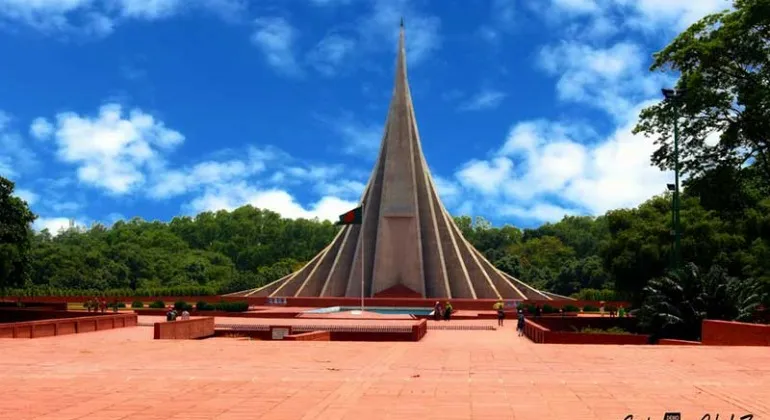
National Martyrs Memorial has been built to commemorate all the brave martyrs who sacrificed their lives in the Great Liberation War of 1971. This memorial complex has been set up in Savar Upazila with an area of 44 hectares at a distance of 35 km from Dhaka. Designed by architect Syed Mainul Hossain, the construction of the memorial was completed in late 1982.
The main structure of the National Memorial is made up of seven pairs of triangular walls. The walls are arranged from small to large. The middle wall is shorter in length but is taller than the other walls in height. The height of the highest point of the memorial is 150 feet. The main structure of the National Memorial is made of concrete. Red bricks are used in all other structures of the monument which evokes the legend of freedom in the blood-stained land. The monument looks different from different angles, which indicates the uniqueness of this monument.
Why seven pillars in the memorial?
The monument consists of seven pairs of triangles. The seven pairs of walls of the National Memorial represent the seven different phases of the freedom movement. The stages are:
The National Memorial Complex includes artificial water bodies, gardens and historical slaughterhouses and mass graves to commemorate the brutality of the Pak forces in 1971. The slaughterhouse and mass graves were discovered after the liberation war, which has been attached to the original structure of the memorial. In front of the national memorial there is a water tank full of the national flower of Bangladesh. The reflection of the national monument in this reservoir creates a magnificent view.
There is no entrance fee to the National Memorial. The National Memorial is open daily from 6 AM to 6 PM for visiting visitors.


 ColoZai