Haripur Rajbari Thakurgaon: History, Architecture and Complete Travel Guide

Haripur Rajbari Thakurgaon: History, Architecture and Complete Travel Guide

Thakurgaon
·

17 October 2026

Travel Overview & Quick Facts

Location
Thakurgaon
Admission / Entry Fee
No verified entry fee has been released by the District Tourism Authority. The palace is a historical heritage site, not a commercial attraction with a specific ticket counter. Visitors should check with the local authorities for entry arrangements and any applicable charges before visiting.
Best Time to Visit
October to March
Opening Hours
No officially verified opening hours are available. Visit during the day and confirm entry locally before traveling.
Category / Type
Historical monuments, Zamindar palaces, architectural heritage, cultural heritage sites

Introduction to Haripur Rajbari Thakurgaon: History, Architecture and Complete Travel Guide

Haripur Rajbari, also known as Haripur Zamindar Bari, is one of the most historically important heritage sites in Haripur Upazila of Thakurgaon District, Bangladesh. Located in the heart of Haripur, this former zamindar residence preserves the memory of a prominent landowner family, the architectural heritage of colonial-era Bengal, and the cultural history of northern Bangladesh.

The palace is associated with Raghavendra Roy Chowdhury and Jagendra Narayan Roy Chowdhury, descendants of Ghanshyam Kundu and subsequent zamindars. According to official records of the Thakurgaon district administration, the construction of the main palace was completed in 1893, and another residence of a branch of the family was built in 1903. These buildings are important monuments to the social, economic and architectural development of the region in the 19th and early 20th centuries.

Unlike a modern amusement park or a complex built for tourism, Haripur Rajbari is primarily a destination for history buffs, photographers, architecture lovers, and travelers interested in lesser-known heritage sites. Its appeal lies in its historic buildings, surviving decorative features, and the stories associated with the erstwhile zamindari system.

While exploring the larger district, visitors can also consider the Palace of King Tankonath, another important historical residence, to get a more comprehensive idea of ​​Thakurgaon's elite architectural heritage.


History of Haripur Palace

The history of Haripur Rajbari is associated with the rise of the Kundu family's landed estates in the region. Official district records indicate that Ghanshyam Kundu, who was involved in the textile trade, arrived in Haripur around 1400 AD. The same historical account describes how a portion of the local zamindari of a landowner named Meherunnesa was auctioned off due to arrears of revenue, which gave members of the Kundu family the opportunity to acquire land.

A few generations later, during the British colonial period, Raghavendra Roy Chowdhury began the construction of the palace. According to the district administration's tradition, his son Jagendra Narayan Roy Chowdhury completed the construction of the main residence in 1893. Jagendra Narayan was later awarded the honorary title of 'Rajarshi' by the British government.

The family residence became an important symbol of the family's status and cultural tastes. Historical accounts indicate that a large library was attached to the palace, reflecting their interest in learning and intellectual life. The original library no longer survives, and the former grand entrance gate has also disappeared.

Around the turn of the 20th century, the family split into separate branches and the estate became divided into two main residential areas. The residence associated with Raghavendra and Jagendra Narayan became known as the Bigger Taraf or Greater Branch. To the west of this, Nagendra Bihari Roy Chowdhury and Girija Ballabh Roy Chowdhury built the Smaller Taraf or Lesser Branch in 1903.

These developments make Haripur Rajbari particularly interesting in understanding the influence of family inheritance, land ownership, and the social structure of the colonial period on the architecture and layout of Bengal's historic estates.


Architecture and notable features

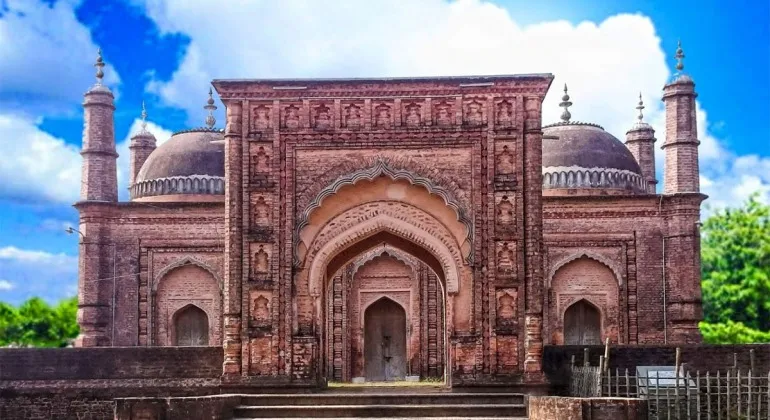
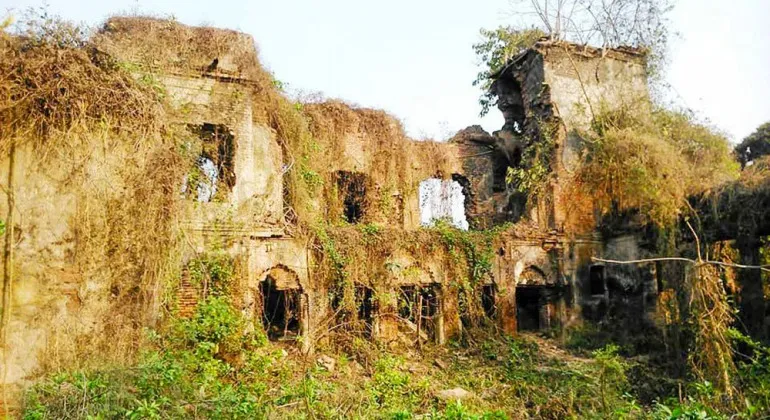
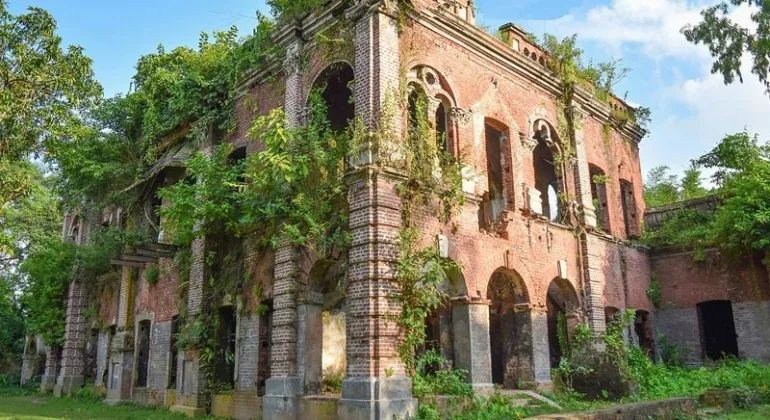
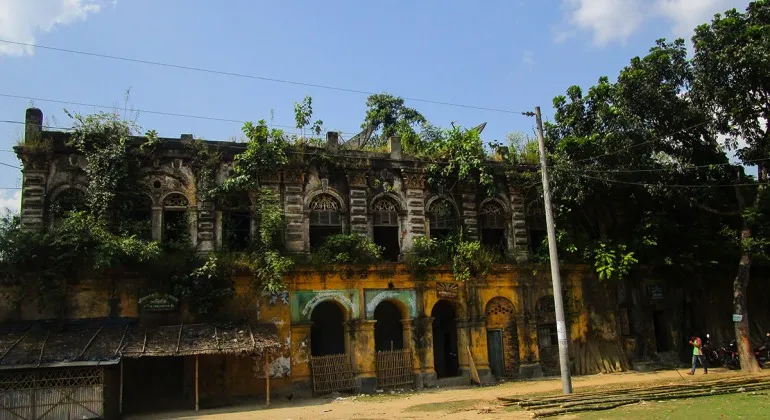
Haripur Rajbari is notable for its royal architecture, surviving ornamentation, and architectural elements described in official heritage documents. Although the complex has fallen into disrepair and some of its original features have been lost, it remains a valuable destination for visitors interested in historic buildings.

Two-story palace

The main residence, built by Jagendra Narayan Roy Chowdhury, is described as a two-storey building. Its exterior incorporates a decorative design inspired by creepers, a characteristic decoration of many historic residences built during the colonial era, combining local building traditions with the tastes of wealthy landlord families.

Fourteen busts of Jagendra Narayan Roy Chowdhury

One of the most distinctive features recorded by the district administration is a group of fourteen busts of Jagendra Narayan Roy Chowdhury, installed on the upper part of the eastern wall. This sculptural detail is particularly noteworthy for architecture lovers and visitors studying the visual representation of authority and family identity in historical Bengal.

Shiva Temple and Nat Temple

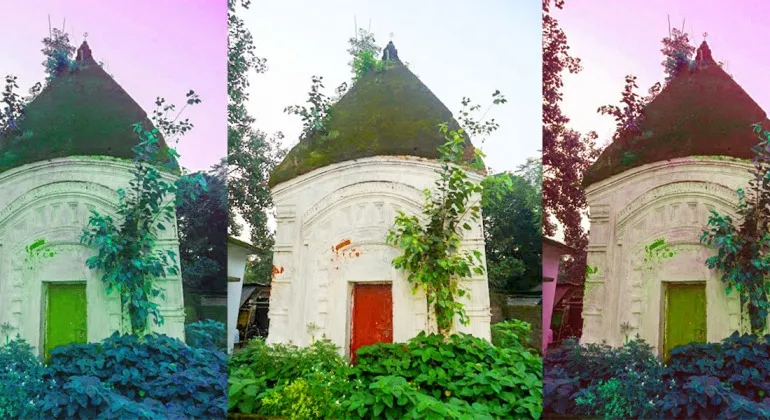
There is mention of a Shiva temple and a Nat temple to the east of the palace, a structure traditionally associated with religious and ceremonial activities. Together, these features reflect the religious and cultural dimension of this historic estate. Visitors should be respectful of any surviving religious structures and refrain from entering protected or structurally unsafe areas.

Lost Gateway and Library

Historical accounts mention a grand entrance and a large library, but according to official district records, neither of these survives in their original form. Their absence highlights the importance of heritage documentation and preservation in understanding buildings that have changed significantly over time.

Big side and small side

There is another reason to explore the grounds carefully, as the estate is divided into a large and small estate. These names do not refer to separate modern tourist attractions, but rather to the large and small branches of the family. Check with the local authorities to ensure that the surviving buildings are accessible during your visit.


Things to do in Haripur Rajbari

Rather than a traditional sightseeing tour with extensive visitor facilities, a visit to Haripur Rajbari is better viewed as a heritage walk. Allow ample time to take in the surviving structures, study the architectural details, and learn about the family history.

  • Explore the exterior architecture: Observe the two-story palace's proportional structure, its ornate surfaces, and surviving historic masonry from the public spaces.
  • Find out details about historical sculptures: Check locally to see if documented busts associated with Jagendra Narayan Roy Chowdhury are still visible.
  • Learn about the two branches of the estate: understand the difference between the grand and the small side, and discover how family divisions have shaped this complex area.
  • Document the heritage with respect: Photographing exteriors open to the public is allowed, but ask permission before photographing people, offices, religious activities, or private interior spaces.
  • Talk to local residents: Local accounts can provide essential context about the changes to the buildings, their current use, and the family's place in Haripur's history. If not independently documented, consider oral traditions as local accounts.
  • Combine this trip with other historical sites: Travelers can plan a larger district itinerary centered around jogdol Palace and other documented heritage sites.

Since the site is not registered as a fully developed tourist destination, visitors should not assume that guided tours, information boards, restrooms, parking facilities, or refreshments will be available within the palace grounds.


Ticket prices and entry rules

No reliable and recent government source confirms any specific entry ticket or published entry fee for Haripur Rajbari. The available district tourism information describes the site as a historical palace, but no commercial ticket prices have been set for it. Therefore, visitors should not rely on unverified online prices.

Access: Consider admission fees uncertain, do not assume that all areas are freely accessible. Ask local authorities or representatives of the relevant site whether the grounds and buildings are open to visitors and whether any admission fees or permits are required.

Guidelines for visitors:

  • Show respect for private property, administrative offices, and any areas used by local organizations.
  • Do not enter locked rooms, unstable buildings, or restricted areas.
  • Avoid touching, climbing on, or removing historical architectural monuments.
  • Ask permission before using a tripod or taking photos of people and interiors.
  • Keep the premises clean and dispose of trash responsibly.
  • Wear appropriate clothing when visiting the respective Shiva temple or other religious places.

Since opening times and space management may change, it is advisable to confirm access before long journeys.


How to reach

Haripur Rajbari is located in Haripur Upazila in the southern part of Thakurgaon District in northwestern Bangladesh. The convenient way to get there is to first reach Thakurgaon and from there take the road to Haripur town. The palace is located in the central area of ​​the upazila.

Step 1: Travel from Dhaka to Thakurgaon

By bus: Intercity buses operate between Dhaka and Thakurgaon. Depending on the operator, buses usually depart from the main bus terminals in Dhaka, such as Gabtoli and other northern route departure points. The journey time usually takes 8-12 hours, but can vary depending on traffic, bus departure times, and road conditions. As a rough guide, budget around 800-1,800 taka per person for a one-way ticket, depending on the service and seat class. Confirm the current schedule and fare with the operator before you set off.

By train: Take a train from Dhaka to Thakurgaon Road Railway Station. Trains operating on the Dhaka-Panchagarh corridor include Ekta Express, Pratijan Express and Panchagarh Express; check the current schedule and stoppages before booking your ticket. The journey usually takes around 9-12 hours, depending on the service and schedule. Fares vary depending on the class of seat and the current railway tariff.

By Air: There is no regular commercial passenger airport in Thakurgaon city. Passengers considering flying should check the current domestic service to an alternative airport such as Saidpur and then arrange for onward road transport. This option may involve a significant additional road journey and should be compared to direct bus or train travel.

Step 2: Continue your journey from Thakurgaon city towards Haripur.

From Thakurgaon town, travel to Haripur by local bus, shared CNG auto-rickshaw or reserved car. The road distance is about 40-50 km depending on the route and starting point and it usually takes about 1.5 to 2.5 hours. Allow extra time for breaks and local traffic jams along the way.

  • Local bus: This is usually a cheaper option. Fares and departure points depend on the current route and operator; confirm your destination with the conductor before boarding the bus.
  • Shared CNG or Auto Rickshaw: A viable option if available. Confirm the fare and whether the vehicle goes directly to Haripur town or just stops at some intermediate stops.
  • Reserved CNG or Car: This is suitable for families, photographers, and tourists planning to stop at multiple heritage sites. Depending on the type of car, waiting time, and bargaining, a reserved local car can cost an estimated ৳1,500–৳3,500 or more for a long return trip. This is an estimate, not a verified local fare.

Step 3: Reach the palace from Haripur city

Upon reaching Haripur, look for Haripur Rajbari or Haripur Zamindar Bari. According to the local administration, the palace is located in the heart of the upazila. Depending on your destination, it may be possible to reach in a short time by local auto-rickshaw, CNG or rickshaw. Confirm local fares before travelling; no reliable current fare list is available.

Practical tips for traveling

  • If you plan to return to the city on the same day, leave Thakurgaon early in the morning.
  • Download offline maps before leaving big cities, as mobile connectivity and direction accuracy can vary.
  • Carry cash for local transportation and meals.
  • Ask the driver to confirm the destination as Haripur Rajbari in Thakurgaon district, and not as any other place named Haripur in Bangladesh.
  • If you are traveling late in the day, make arrangements for a return ride in advance.
  • For a longer traditional itinerary, (Palace of King Tankonath) you may want to consider combining it with a visit to King Tankonatha's Palace, but check the distance and road conditions before finalizing the route.

Where to eat

Haripur town is the most convenient place for a daily meal before or after visiting the palace. Local restaurants and small food stalls in the city center offer familiar Bangladeshi dishes such as rice, dal, vegetables, fish, and chicken, as well as tea and light snacks.

No specific restaurants have been confirmed inside the palace, so plan to eat in town rather than relying on the dining options within the heritage area. Availability and opening times may vary, especially in the evening.

What to try

  • Traditional rice dish: A convenient option for lunch before returning to Thakurgaon.
  • Local tea and snacks: Small tea shops can be quite useful for short breaks between journeys in one or more vehicles.
  • Seasonal regional produce: Ask local vendors about the fruits and other products available during your visit.

If the journey between the heritage sites is likely to take several hours, bring drinking water and some light snacks. Travelers with dietary restrictions should ask restaurant staff directly about ingredients and preparation methods.


Where to stay?

For most visitors, the most convenient overnight stop is Thakurgaon, as it is the district headquarters and main transport hub. Travelers can check out the local hotels and guesthouses there and then head to Haripur for a day.

Accommodation options in Haripur town itself may be more limited. It has not been verified whether there are any specific hotels within walking distance of the palace, so check current listings, recent reviews, amenities, and availability before booking.

Choosing your base

  • Staying in Thakurgaon city: Suitable for travelers arriving by train or intercity bus who want access to transportation, shops, and food.
  • Staying in Haripur: Consider this only after ensuring that you have suitable accommodation available on your scheduled dates.
  • Plan a multi-day trip to the district: Visitors who want to visit multiple attractions should choose their accommodation based on their complete itinerary and onward transportation convenience.

Before reserving a room, make sure to check the availability of a private bathroom, hot water if needed, cancellation policy, and distance from the railway station or bus terminal at check-in. It is advisable to book in advance for travel on public holidays.


Photography and responsible heritage tourism

Haripur Rajbari can be a great place to take architectural photographs, especially for travelers interested in historic masonry, ornate surfaces, old gateways, and the relationship between palace buildings and associated religious structures.

Take photos of the property from a location open to the public and follow any instructions from the caretaker or local authorities. Do not enter damaged structures, climb walls, or move architectural components to take photos. Historic buildings may have hidden structural weaknesses, even if their exteriors appear intact.

Responsible visiting also helps preserve local history. Avoid littering, be respectful of the people who use the space for their daily activities, and distinguish verified historical information from legends or household stories told by local residents.


Frequently Asked Questions

The following answers answer questions regarding practical planning for a visit to Haripur Rajbari in Thakurgaon district. Details such as opening times, entry restrictions and transport fares should be confirmed locally, as reliable up-to-date tourist information is lacking.


Nearby attractions

Tourists interested in the historical architecture and local culture of northern Bangladesh can extend their tour beyond Haripur Rajbari. The following places of interest are located in Thakurgaon district, although not all of them are right next to the palace. Check distances and transport connections before planning a comprehensive itinerary.

For a realistic itinerary, rather than trying to visit everything in one day, select attractions based on their actual road distance. In places where there is no convenient direct public transport connection, local car or CNG arrangements can be made to make travel easier.

Frequently Asked Questions (FAQ)

Haripur Rajbari is located in the central part of Haripur Upazila of Thakurgaon District in northwestern Bangladesh. Visitors from Thakurgaon city usually proceed towards Haripur by road and then use local transport or directions from residents to find the palace. Make sure that Thakurgaon District is mentioned in your navigation destination.

Explore The Area

Top Attractions & Places to Visit in Thakurgaon

Discover more heritage, nature, and must-visit spots across Thakurgaon.

View all in Thakurgaon

Balia Mosque Thakurgaon: History, Architecture, Jain Legends and Complete Travel Guide

The Balia Mosque of Thakurgaon, also known as the Chota Balia Jame Mosque and the legendary Jin Mosque (Jin's Mosque) , ...

Shafayet Al-Anik

Funcity Amusement Park Thakurgaon: Complete travel guide to this family fun park in Pirganj

Funcity Amusement Park Thakurgaon, also known as Funcity Children's Park or Funcity Shishu Park, is a popular family ent...

Shafayet Al-Anik

Harinmari Shiva Temple Thakurgaon

Visit the Harinmari Shiva Temple, an important example of traditional Bengali temple architecture located at Harinmari H...

Shafayet Al-Anik

Jamalpur Zamindarbari Jame Mosque Thakurgaon

Learn about the extraordinary heritage of Jamalpur Zamindarbari Jame Mosque, one of the historical religious and archite...

Shafayet Al-Anik

Jogdal Rajbari Thakurgaon

Jogdal Rajbari , also known as Jagdal Rajbari, is a historic palace complex located in Jagdal area of ​​Kashipur Union, ...

Shafayet Al-Anik

Palace of King Tankonath

Raja Tonknath Palace, also known as Raja Tonknath Rajbari, Rani Shankal Rajbari or Malduar Zamindar Bari , is one of the...

Shafayet Al-Anik

Shalbari Mosque and Imambara Thakurgaon: History, Architecture and Travel Guide

Hidden among the shalwar kameez trees near Bhawalarhat, about 20 kilometers west of Thakurgaon Sadar, the Shalbari Mosqu...

Shafayet Al-Anik

logo ColoZai

ColoZai is a trusted travel guide and destination explorer platform in Bangladesh. We are making travel simple, authentic, and accessible for everyone.

Need Help ?

We are Always here for you! Knock us on Whatsapp (10AM - 10PM) or Email us.